Choosing a borosilicate glass food container manufacturer requires more than comparing catalogue photographs and unit prices. Importers, distributors and retailers also need to review product specifications, lids and sealing components, documentation, packaging, order flexibility and the supplier’s communication process.
A suitable manufacturer should provide clear information for each selected product and identify any details that still require confirmation. The objective is not simply to find the lowest quotation. It is to build a repeatable sourcing process that supports product selection, sampling, shipment preparation and future reorders.
Begin With a Clear Sourcing Brief
Before contacting manufacturers, define what you plan to sell and where you plan to sell it. A homeware retailer, hospitality supplier and private-label e-commerce brand may need different product combinations.
Your initial brief should include:
- Preferred shapes, such as rectangular, square or round
- Required capacities
- Standard or compartmented containers
- Preferred lid or closure type
- Individual products or retail sets
- Estimated quantity for each model
- Destination country
- Standard or customized packaging
- Required testing or documentation
- Target sales channel
Estimates are acceptable at the early sourcing stage. However, quantities should still be separated by model because availability, carton configuration and customization requirements may differ between individual SKUs.
Buyers can begin by reviewing the borosilicate glass food storage container collection and identifying suitable shapes, capacities and lid formats.
Compare Products at SKU Level
A large catalogue does not automatically make a manufacturer suitable for your business. The more important question is whether the supplier can provide accurate information for the individual models you are considering.
Request the following details for each product code:
| Item | What to Confirm |
|---|---|
| Capacity | Nominal capacity and how it is defined |
| Dimensions | External product dimensions and applicable tolerances |
| Components | Glass body, lid, seal, valve or other accessories |
| Packaging | Inner packing method and pieces per carton |
| Carton data | Outer carton dimensions, gross weight and net weight |
| Availability | Current stock or production status |
| Order quantity | MOQ and full-carton requirements |
| Documentation | Documents applicable to the product and destination market |
This information helps buyers compare models, prepare freight estimates and decide whether several containers can form a coordinated retail range.
Do not rely only on a photograph or a general description such as “medium rectangular container.” Similar-looking products may have different dimensions, lid structures, carton quantities or intended uses.
Evaluate the Complete Container
A glass food storage container is a multi-component product. The glass body, lid, gasket, valve and closure mechanism may use different materials and must be reviewed separately.
Ask the manufacturer to confirm:
- The material of the glass body
- The material and structure of the lid
- The material of the gasket or sealing ring
- The closure mechanism
- Whether the lid includes a valve, button or removable component
- Cleaning and use instructions for the individual components
- Which documents apply to the glass body and which apply to accessories
A glass-body material report should not be treated as evidence covering the lid, gasket or complete finished product. Likewise, performance information for one container should not automatically be applied to every model in a collection.
If leakage resistance is important, evaluate the actual glass body, lid and gasket together. The fit and operation of the complete assembly matter more than a general description of the lid material.
For additional material context, read what our glass-body composition reports cover.
Review Specification and Quality-Control Procedures
Ask potential manufacturers how product requirements are recorded and checked for an order. Depending on the selected model and agreed inspection criteria, the review may cover:
- Product appearance
- Capacity and dimensions
- Rim and edge condition
- Lid fit
- Closure operation
- Gasket placement
- Logo or decoration position
- Packing method
- Carton configuration
- Carton markings
- Final order quantities
If your company has its own inspection requirements, send them before quotation or order confirmation. The supplier can then review whether the requested checks can be included.
A customer-appointed or independent third-party inspection may also be discussed. Its scope, timing and cost should be agreed before shipment.
The HENGSHENGFAN quality and packaging page explains why inspection requirements and supporting documents must be reviewed according to the selected product and order.
Request Product- and Market-Specific Documentation
Documentation is one of the most important areas to review when choosing a manufacturer. Available reports may depend on:
- The specific product code
- The glass body
- The lid and other accessories
- The intended use
- The destination market
- The standard requested by the buyer
Do not assume that one report applies to every container or component in the catalogue.
Send the manufacturer your product codes, intended use, destination country and required standard. Ask which existing documents are applicable and whether additional testing or documentation will be required.
A responsible answer should distinguish between:
- Documents already available for the selected product or component
- Documents that require an applicability review
- New testing or documentation that may need to be arranged
This approach is more useful than a general statement that every product meets every possible market requirement.
Review Packing and Shipment Preparation
Glassware packaging must be considered as part of the product, especially for international distribution. Packaging requirements may differ according to the product shape, carton configuration, transport route and retail channel.
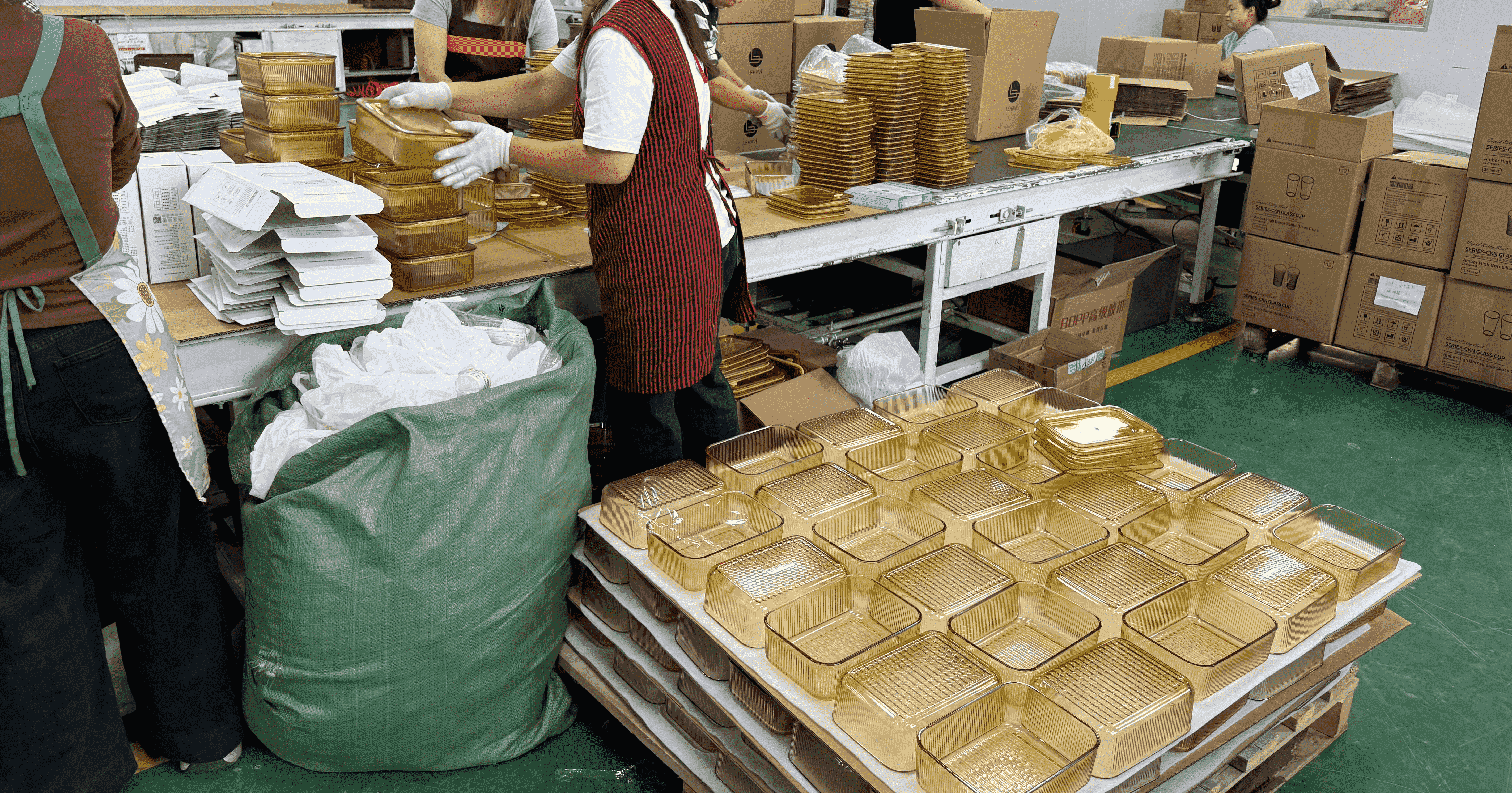
The factory image above shows glass food containers being handled and prepared for packing. It should be presented as an actual packing scene, rather than evidence of a specific packaging test unless that test has been separately confirmed.
Ask the supplier to provide or confirm:
- Individual product protection
- Dividers, inserts or partitions
- Inner-box configuration
- Pieces per export carton
- Outer carton dimensions
- Gross and net carton weight
- Shipping marks
- Barcode and label positions
- Pallet requirements, if applicable
- Retail-box requirements for sets
If you are developing a set, confirm how different capacities will be arranged and protected. Standard export packaging for individual products may not be suitable as customer-facing retail packaging.
Compare Trial Orders, Mixed Models and Repeat-Order Needs
For selected in-stock products, low trial quantities may help buyers evaluate several models before placing a larger order. Availability still depends on the specific product, stock status and carton configuration.
Ask each supplier:
- Whether a trial order is available
- Whether different models can be combined
- The required quantity for each product code
- Whether full cartons are required
- Which models are currently in stock
- How repeat orders are handled
- Which conditions may change the MOQ
Mixed-model purchasing can be useful when building an initial collection, but every model should still have a clearly stated quantity. Packaging and freight information must be calculated using the final selection.
You can explore the complete glassware collection and select individual models for a combined quotation.
Understand OEM and Private-Label Requirements
Private-label projects may involve logos, printing, decals, labels, barcodes, inserts, retail boxes or shipping marks. These processes do not necessarily have the same minimum quantity.
For an initial customization review, prepare:
- Product code
- Quantity per SKU
- Logo or artwork
- Preferred logo position
- Color references
- Packaging reference
- Barcode and label requirements
- Destination market
Custom branded packaging typically requires 3,000–5,000 pieces per individual SKU, depending on the product, box structure and printing requirements.
Different product models should not be combined when calculating this custom packaging MOQ. Costs, sample requirements, artwork approval and production arrangements should be confirmed for each project.
Review the available OEM, private-label and packaging options before preparing your enquiry.
Use Samples and Trial Orders to Reduce Uncertainty
Samples allow buyers to evaluate the selected product before making a larger commercial commitment.
A sample review can include:
- Overall shape and appearance
- Actual capacity
- Product dimensions
- Rim and edge finishing
- Lid alignment
- Closure operation
- Gasket fit
- Stacking or nesting
- Label placement
- Retail presentation
- Proposed packaging
Record the product code and sample version. If changes are requested, ensure that the revised sample or approved specification is clearly identified before production.
A flexible trial order can also provide practical information about carton handling, warehouse reception and customer response across multiple models.
Compare Complete Quotations, Not Only Unit Prices
A useful quotation should give buyers enough information to compare the actual commercial offer.
Confirm that it includes:
| Quotation Item | Why It Matters |
|---|---|
| Product code | Prevents confusion between similar models |
| Quantity by model | Supports accurate pricing and packing |
| Unit price and currency | Establishes the commercial basis |
| Trade terms | Clarifies cost and delivery responsibilities |
| Packaging method | Affects protection, presentation and freight |
| Carton information | Supports storage and shipment planning |
| MOQ | Shows the commitment required per model |
| Sample terms | Clarifies sample cost and arrangements |
| Customization costs | Separates standard and branded options |
| Production timing | Must be confirmed for the actual order |
| Payment terms | Supports internal purchasing approval |
| Quotation validity | Identifies how long the offer remains open |
Prices, availability, packaging and production schedules should be confirmed for the selected order. Avoid treating a general estimate as a fixed commitment.
Evaluate Communication and Factory Coordination
Clear communication is part of supplier performance. During the quotation and sampling process, observe whether the supplier:
- Answers questions by product code
- Separates confirmed data from pending information
- Identifies differences between models
- Requests destination and intended-use information
- Records revisions clearly
- Confirms packaging and artwork before production
- Explains changes to availability or carton configuration
HENGSHENGFAN is operated by Baoji Hengshengfan Electronic Technology Co., Ltd. Our team coordinates international enquiries, product selection, quotations, packaging requirements and export communication with the manufacturing facilities in Baoji, Shaanxi, China.
Buyers can learn more about the company and manufacturing facilities.
Manufacturer Evaluation Checklist
Before choosing a borosilicate glass food container manufacturer, confirm that you have reviewed:
- The product range and available capacities
- Specifications for each selected product code
- Glass bodies, lids and sealing components separately
- Product and market-specific documentation
- Inspection requirements
- Export and retail packaging
- Trial-order and mixed-model conditions
- Samples and approval records
- OEM and private-label requirements
- Complete quotation terms
- Communication and change control
- Support for future repeat orders
The strongest sourcing decision is based on clear product information, documented requirements and a controlled approval process—not unit price alone.
Frequently Asked Questions
Can I place a low-quantity trial order?
Low trial quantities may be available for selected in-stock products. The final quantity depends on the model, current availability and full-carton requirements.
Can different glass food container models be combined?
Mixed-model orders can be discussed. Provide the required quantity for every product code so the supplier can review stock, carton configuration, packaging and shipment arrangements.
How should I assess leakage resistance?
Request a sample of the complete product and evaluate the glass body, lid and gasket together. Leakage resistance should be reviewed for the specific model rather than inferred from a general product description.
Do all glass food containers use the same reports?
No. Available documents depend on the product, material, component, intended use and destination market. Provide the exact product codes and required standards for review.
What is the MOQ for custom branded packaging?
Custom branded packaging typically requires 3,000–5,000 pieces per individual SKU, depending on the product, box structure and printing requirements. Separate SKUs cannot be combined to meet this requirement.
What should I provide when requesting a quotation?
Send your selected product codes or reference images, required quantity by model, destination country, packaging requirements and any customization request. Include required inspection or documentation standards when applicable.
Discuss Your Glass Food Container Project
HENGSHENGFAN supplies borosilicate glass food storage containers for importers, distributors, wholesalers, retailers and private-label buyers.
View our glass food storage container collection, select the models that interest you and share your quantities, destination market and packaging requirements. Our team will review availability, carton configuration, customization options and applicable documentation for your project.
Company: Baoji Hengshengfan Electronic Technology Co., Ltd. Brand: HENGSHENGFAN Email: support@solasienna.com Location: Baoji, Shaanxi, China
Related Reading
What Is in Our Borosilicate Glass? Understanding the Glass Body Composition